How to Use Microsoft Azure Digital Twins: Complete Guide for Businesses in 2026
Discover how Microsoft Azure Digital Twins is revolutionizing enterprise IoT. From modeling complex environments to predictive AI integration, this is your strategic roadmap for 2026.
The industrial landscape of 2026 is defined by one critical imperative: digital concurrency. The gap between the physical world and its digital representation is closing rapidly. For enterprises, this isn't just about monitoring sensor data anymore; it is about creating a living, breathing replica of their physical operations to simulate, predict, and optimize in real-time.
Enter the realm of the Digital Twin. While the concept has existed for years, the execution has often been fragmented, trapped in siloed CAD files or disconnected point solutions. Microsoft Azure Digital Twins (ADT) has emerged as the premier fabric for weaving these disparate threads into a cohesive, intelligent whole. It is no longer a futuristic concept but a operational necessity for businesses aiming to reduce costs, enhance sustainability, and drive innovation in a complex global market.
This guide explores how forward-thinking businesses are leveraging Azure Digital Twins in 2026 to move beyond simple IoT visualization toward autonomous, insight-driven operations.
The Evolution of Digital Twins: From Static Models to Living Graphs
To understand the power of Azure Digital Twins, one must first understand the limitation of traditional IoT. Traditional IoT architectures typically follow a linear path: a sensor emits data, it travels to the cloud, and a dashboard visualizes it. This is "Digital Twin 1.0"—a mirror image that reflects the current state but lacks the context of relationships.
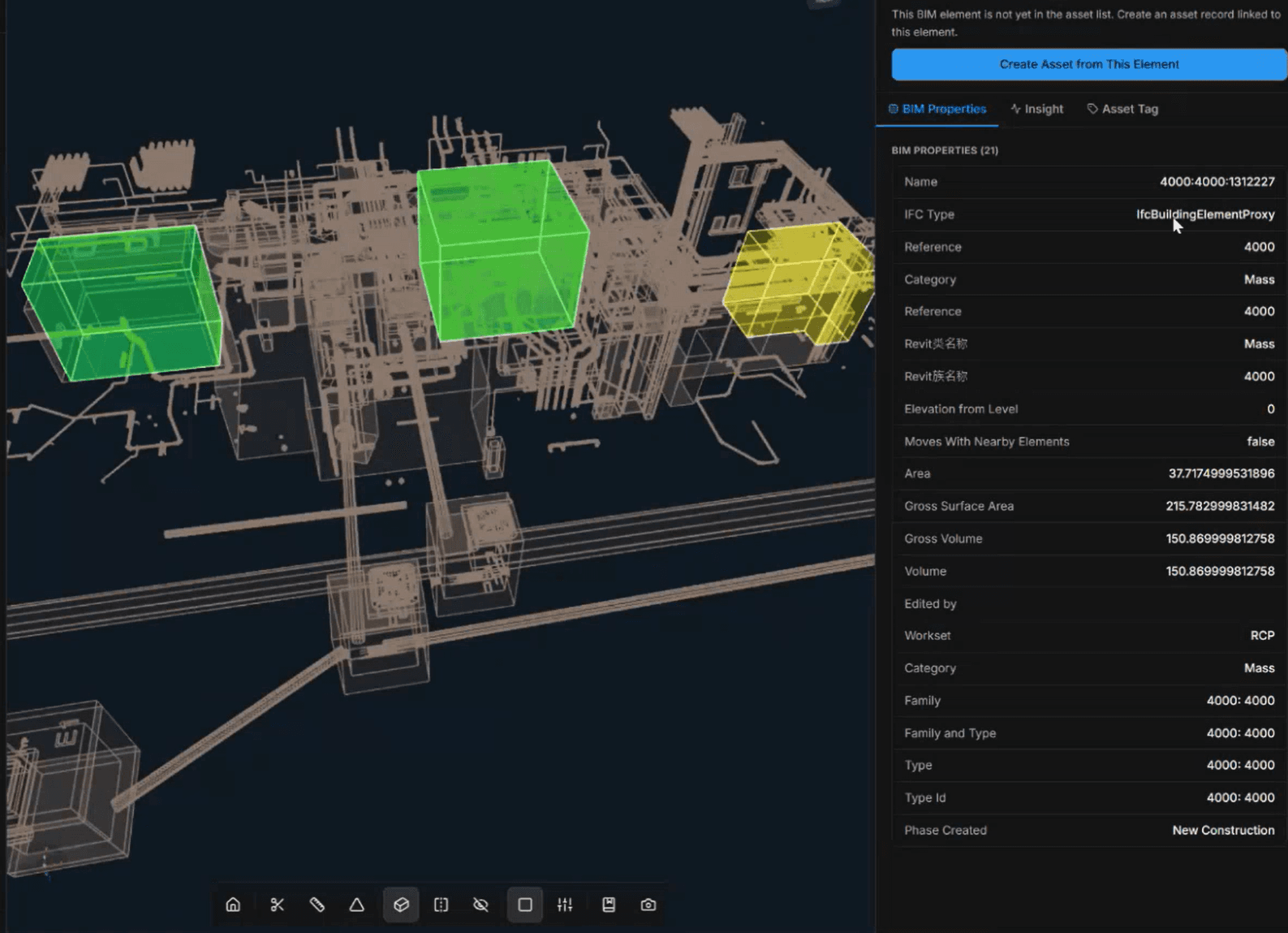
In 2026, leading enterprises utilize "Digital Twin 2.0." Azure Digital Twins facilitates this shift through its core capability: spatial intelligence graph. Unlike a standard database that lists devices, ADT maps the relationships between them. It understands that a "Room" contains a "Sensor," which is attached to an "AHU," and that these relationships define the context of the data.
Why the Graph Matters
The true value of a digital twin lies not in the data points themselves, but in the interconnections. When a temperature sensor spikes in a traditional system, an operator sees a number. In an Azure Digital Twins environment, the system understands that the sensor is located in a clean room critical for pharmaceutical manufacturing. It knows that the specific HVAC unit servicing that room is also due for maintenance.
This contextual awareness allows businesses to move from reactive troubleshooting to predictive operations. By 2026, the ability to query the twin graph to answer "what if" scenarios—such as "What happens to server room cooling if HVAC Unit 3 fails?"—is a standard operational requirement.
Core Architecture: Building Your Digital DNA
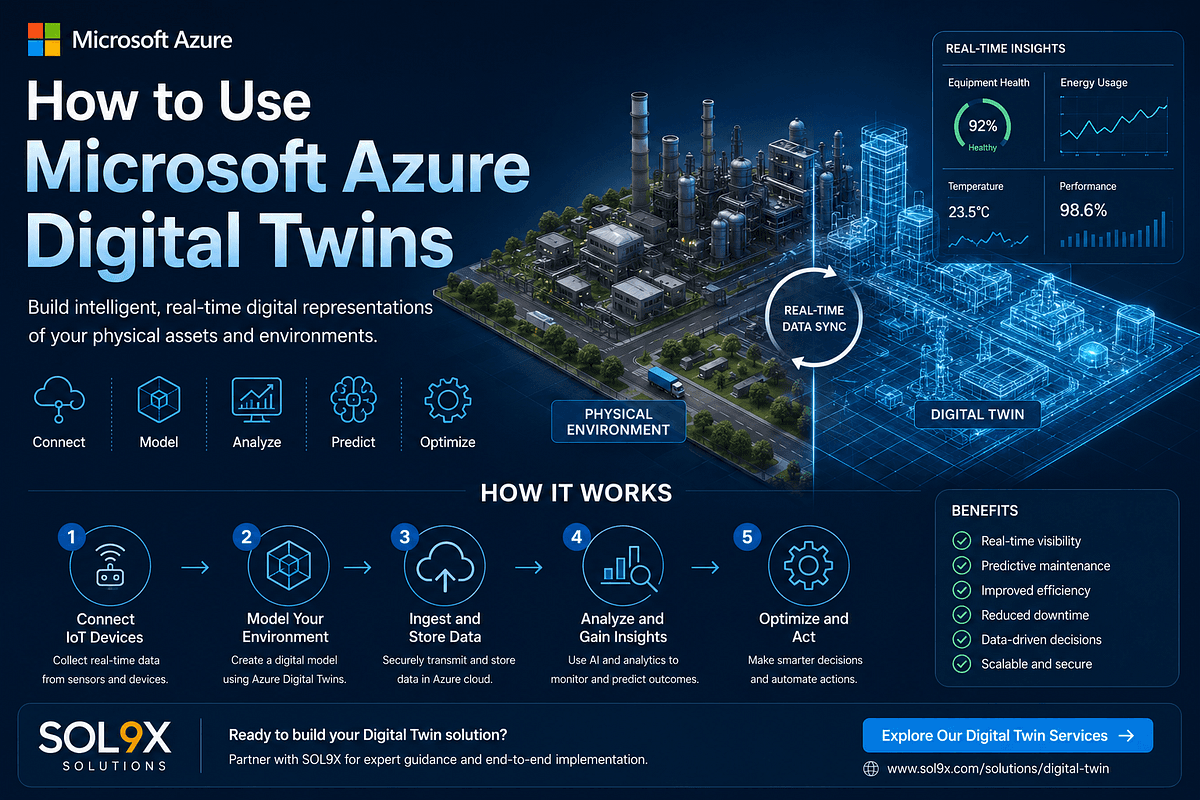
Implementing Azure Digital Twins requires a shift in how IT and OT teams collaborate. The implementation process can be broken down into three foundational pillars: Modeling, Connectivity, and Intelligence.
1. Modeling with DTDL (Digital Twins Definition Language)
The blueprint of any Azure Digital Twin solution is the model. Microsoft uses the Digital Twins Definition Language (DTDL), an open-source language based on JSON-LD. Think of DTDL as the DNA of your digital environment.
- Interfaces: These define the properties (state), telemetry (data streams), and relationships of an entity.
- Inheritance: In complex enterprise environments, modeling efficiency is key. DTDL allows for inheritance, enabling businesses to create a base "Asset" model and extend it for specific sub-types like "Robot" or "Conveyor Belt."
Best Practice for 2026: Rather than modeling individual, generic devices, businesses are increasingly adopting industry-standard vocabularies (such as the Real Estate Digital Twin ontology) to ensure their twins remain interoperable with vendor ecosystems and supply chain partners.
2. Ingesting the Physical Pulse (IoT Integration)
A model is static until it is animated by data. Azure Digital Twins acts as the synchronization layer. The most common pathway involves Azure IoT Hub, which acts as the ingestion gatekeeper.
- The Flow: IoT Hub ingests telemetry $ ightarrow$ Azure Functions (or Data Explorer) processes the data $ ightarrow$ ADT updates the twin properties.
By 2026, however, we are seeing the rise of Edge Digital Twins. Processing is moving closer to the physical asset to handle latency-sensitive operations. A factory floor robot might update its local twin graph instantly to prevent collisions, syncing with the cloud twin only periodically for historical analysis.
3. Querying and Simulation with Compute
Once the digital twin is populated, it must be queried. Azure Digital Twins utilizes a robust, SQL-like query language specifically designed for the graph structure.
Consider a scenario in a smart building. A facility manager needs to identify all spaces that are currently above 75 degrees Fahrenheit but have active occupancy.
- Traditional SQL: Requires complex joins on flat tables.
- ADT Query:
SELECT * FROM DIGITALTWINS T WHERE IS_OF_MODEL(T, 'dtmi:com:contoso:Room;1') AND T.Temperature > 75 AND T.Occupancy = 'True'
This semantic query capability is what allows operators to interact with the logical environment rather than the database rows.
Strategic Applications: Industry Use Cases in 2026
The versatility of Azure Digital Twins allows it to transcend vertical boundaries. However, three specific industries have seen massive ROI from its implementation in the last two years.
1. Manufacturing: The Predictive Factory
In manufacturing, unplanned downtime is the primary cost driver. Companies utilizing ADT are moving from preventive maintenance (scheduled at time intervals) to predictive maintenance (scheduled based on actual condition).
Scenario: A twin of a production line models the vibration, heat, and acoustic signatures of a motor. By integrating with Azure Machine Learning, the twin ingests historical data to identify a "failure signature." Weeks before the motor fails, the system simulates the impact of the failure on the line and automatically schedules the replacement during a low-demand shift.
2. Smart Buildings and Real Estate: Energy Optimization
With the rise of ESG (Environmental, Social, and Governance) reporting, real estate managers are under pressure to reduce carbon footprints. Azure Digital Twins enables "granular grid simulation."
Scenario: An office complex utilizes ADT to model heat transfer based on occupancy sensors and weather forecasts. The system simulates the optimal cooling levels for the next four hours. If the forecast predicts a temperature drop, the twin proactively adjusts the HVAC set-point, reducing energy consumption by 15-20% without impacting tenant comfort.
3. Healthcare: The Connected Hospital
Post-pandemic, healthcare infrastructure has become more intelligent. Hospitals are using digital twins to track not just medical equipment, but patient flow and asset utilization.
Scenario: A hospital creates a twin of its ICU capacity. By integrating with the admission system, the twin predicts bed availability 24 hours in advance based on current occupancy and discharge trends. It simultaneously tracks the location of infusion pumps, ensuring that critical equipment is staged in rooms before patients arrive.
The 2026 Feature Set: AI and Copilot Integration
What distinguishes the 2026 iteration of Azure Digital Twins from the 2020 version is the deep integration of Generative AI and Large Language Models (LLMs).
Operationalizing Copilot
Microsoft has embedded Azure OpenAI Service directly into the Digital Twins workflow. This has democratized access to the twin. Previously, querying the graph required knowledge of the ADT query syntax. Now, facility managers can interact with the twin using natural language.
Example Interaction:
- User: "Show me all conference rooms in the London office that have capacity for more than 10 people but are currently empty."
- Copilot: Translates this request into the underlying ADT graph query, retrieves the results, and can even visualize the result in PowerBI.
Advanced Simulation
The integration of Physics-based engines allows for "Digital Twins in the Loop." Before deploying a software update to a fleet of autonomous mobile robots (AMRs) in a warehouse, the update is first tested against the digital twin of the warehouse to ensure the robots don't collide or fall short on battery range. This dramatically reduces deployment risks in physical environments.
Implementation Roadmap: A Practical Guide for Enterprises
Adopting Azure Digital Twins is a journey, not a software install. For businesses looking to deploy in 2026, here is a tactical roadmap.
Phase 1: Discovery and Modeling (Months 1-3)
Focus on the ontology. Do not start with the devices; start with the relationships. Define the vocabulary of your physical space. What constitutes a "Zone"? What properties does a "Pump" have? If this step is rushed, the digital twin becomes a "digital dump"—expensive and unmanageable.
Phase 2: The Minimum Viable Twin (Months 3-6)
Select a single brownfield site or a specific production line. Do not attempt a global rollout. Connect the critical assets and establish the data flow. The goal here is to prove the value of the "graph context"—showing stakeholders that the twin knows where things are relative to each other.
Phase 3: Insight Integration (Months 6-9)
Overlay the intelligence layer. Connect the twin to Azure Logic Apps, Functions, and Machine Learning. This is where the twin starts sending alerts, not just data. The focus shifts from "monitoring" to "acting."
Phase 4: Scalability and Expansion (Month 12+)
Once the MVP is proven, expand to adjacent facilities. In 2026, this phase often involves connecting multiple twins to form a "Digital Thread" across the supply chain, allowing a manufacturer to see how a supplier's factory performance impacts their own production line.
Security and Governance: Securing the Mirror World
As the digital twin becomes a critical operational asset, its security posture is paramount. Azure Digital Twins relies on Azure Active Directory (Entra ID) for authentication.
Key Security Considerations:
- Role-Based Access Control (RBAC): Not all users should see all twins. An executive might need a high-level view of a facility, while a maintenance technician needs detailed access to a specific machine. ADT allows for granular permissions mapping.
- Data Sovereignty: In 2026, data residency laws are stricter. Azure allows businesses to pin their ADT instances to specific geographic regions, ensuring that data regarding critical infrastructure never crosses legal borders.
- Endpoint Security: The connection between the physical device and the twin is the most vulnerable link. utilizing Managed Identities for Azure Functions ensures that there are no hardcoded credentials in the synchronization code.
Overcoming Common Challenges
While the technology is mature, implementation hurdles remain. The most common pitfall is the "Garbage In, Garbage Out" phenomenon. If the physical sensors are uncalibrated or the data models are poorly defined, the twin will hallucinate relationships.
Another challenge is organizational silos. ADT projects often fail because the OT (Operational Technology) team owns the devices but the IT (Information Technology) team owns the cloud. Successful implementation requires a unified "Twin Team" with representation from both sides, reporting directly to C-level leadership.
Future Outlook: The Convergence of Twins
Looking beyond 2026, the trajectory points toward Twinned Supply Chains. Currently, Azure Digital Twins often focuses on the four walls of a factory or a building. The future lies in federating these twins. A disruption in a port (Modeled in ADT) will automatically trigger a rescheduling of production lines (Modeled in ADT) and alert logistics networks (Modeled in ADT).
Furthermore, the rise of Digital Threads will allow the twin to accompany a physical product throughout its lifecycle. A jet engine manufactured by GE or Rolls Royce could have a twin that stays with it from manufacturing, through flight operations, into maintenance, and finally, decommissioning. The Azure ecosystem provides the scalability to maintain this persistent identity.
Conclusion
Microsoft Azure Digital Twins has graduated from a niche IoT tool to the backbone of modern enterprise operations. For businesses in 2026, the question is no longer if they should digitize their physical assets, but how quickly they can map their reality to the digital graph.
By adopting a strategy centered on strong modeling, robust AI integration, and a phased implementation approach, businesses can unlock unprecedented operational efficiency. The digital twin is the closest thing to a crystal ball that the modern industry possesses—offering the clarity needed to navigate a volatile future with confidence.
Frequently Asked Questions (FAQ)
1. What is the primary difference between Azure Digital Twins and a standard IoT Dashboard? Standard IoT dashboards visualize data points, often in isolation. Azure Digital Twins creates a knowledge graph that maps the relationships between entities. While a dashboard can show you a sensor's temperature is high, a Digital Twin understands that the sensor is in a specific room, connected to a specific HVAC unit, and can predict the impact of that failure on the larger system.
2. Is coding knowledge required to use Azure Digital Twins? While the initial setup and modeling (DTDL) require developer skills (C#, Python, or Node.js), the end-user experience is increasingly no-code. With Power BI integration and the new Copilot features, stakeholders can query and interact with the twin using natural language or drag-and-drop visualizations without writing code.
3. Can Azure Digital Twins connect with legacy industrial equipment? Yes. Azure utilizes IoT Edge and Azure IoT Operations to bridge the gap between legacy protocols (such as Modbus, OPC-UA, or BACnet) and the cloud. An edge gateway can translate data from legacy machinery and update the Digital Twin in the cloud in real-time.
4. How much does Azure Digital Twins cost? Azure Digital Twins usage is billed based on the number of Digital Twin nodes created and the number of API calls made to interact with them. There is no upfront infrastructure cost, making it a scalable OpEx model suitable for pilot projects and massive rollouts alike.
5. Is my data secure in Azure Digital Twins? Security is a core tenant of the service. Data is encrypted in transit and at rest. Azure Digital Twins integrates natively with Azure Active Directory (Entra ID) for granular access control, ensuring that only authorized personnel can view or interact with critical infrastructure models.
6. How does this integrate with other Microsoft services? ADT is the "brain" of the operation, but it relies on a muscle system. It integrates deeply with Azure IoT Hub (ingestion), Azure Data Explorer (historical analytics), Azure Machine Learning (predictive AI), and Power BI (visualization). This tight integration within the Azure ecosystem is its primary advantage over standalone digital twin software.
7. Can I simulate "What-If" scenarios? Absolutely. This is one of the most powerful features of the platform. You can manipulate the state of the digital twin (e.g., set a temperature to a high value or set a device to 'maintenance mode') and run queries to see how it affects connected nodes. Advanced users integrate simulation engines to test physics-based scenarios before deploying changes to the real world.