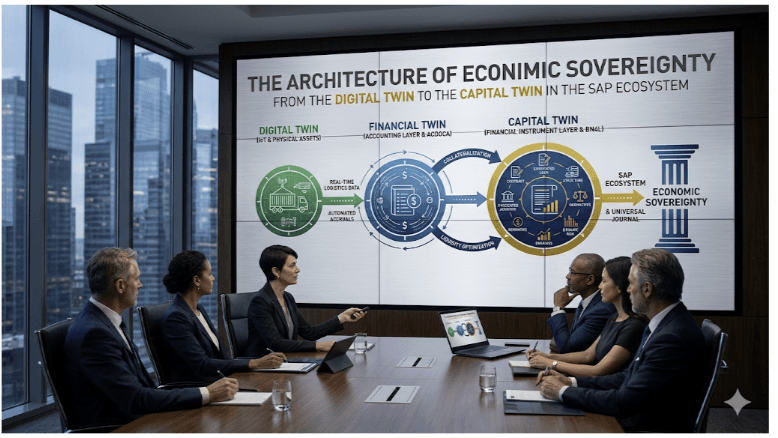
The Architecture of Economic Sovereignty: From the Digital Twin to the Capital Twin in the SAP Ecosystem
Discover how the evolution from Digital Twins to Capital Twins within SAP architectures is redefining enterprise value, enhancing economic sovereignty, and bridging the critical gap between operational performance and financial reality.
The architectural landscape of Enterprise Resource Planning (ERP) has undergone a radical transformation over the last decade. For years, the primary objective of digital transformation was visibility—knowing what is happening within the supply chain, the factory floor, or the logistics network. However, as we move further into the era of the Intelligent Enterprise, the goalpost has shifted. Visibility is no longer enough; organizations now require economic sovereignty.
This new paradigm demands a seamless connection between the physical reality of operations and the financial reality of the balance sheet. To achieve this, a revolutionary concept is emerging within the SAP ecosystem: the Capital Twin.
While the Digital Twin has long been the gold standard for modeling physical assets, the Capital Twin completes the picture by modeling the economic lifeblood of those assets. This evolution represents a fundamental shift in how businesses approach value, risk, and sustainability.
The Limitations of the Traditional Digital Twin
To understand where we are going, we must first examine the limitations of current models. The concept of the Digital Twin—a virtual replica of a physical entity—has transformed industrial IoT. In the SAP environment, Digital Twin technology (often powered by SAP Digital Manufacturing and IoT services) allows engineers to visualize machinery, predict maintenance needs, and simulate production scenarios.
However, traditional Digital Twins operate largely in the domain of engineering and operations. They measure vibration, temperature, throughput, and cycle times. While this data is operationally vital, it often exists in a silo, detached from the financial engines that drive corporate decision-making.
The Operational-Financial Disconnect
Consider a typical scenario: A manufacturing plant uses a Digital Twin to optimize a production line. The twin suggests increasing the speed of a conveyor belt to boost output. Operationally, this is a success—production rises by 15%.
But what is the cost?
- Does the increased speed depreciate the asset faster, raising maintenance costs?
- Does the energy consumption spike, eroding margin?
- How does this change impact the real-time valuation of the asset on the balance sheet?
Without a direct link to financial systems, the CFO remains blind to these implications until the end of the quarter. By then, the operational “win” might have translated into a financial loss. This disconnect is the Achilles' heel of modern ERP architecture.
Introducing the Capital Twin: Bridging the Gap
The Capital Twin is the architectural evolution designed to bridge this gap. It extends the concept of the Digital Twin beyond physical telemetry to include financial and economic metadata. In the context of SAP, this means integrating real-time operational data directly with the financial modules (SAP S/4HANA Finance, SAP Controlling) and sustainability ledgers (SAP Sustainability Control Room).
The Capital Twin answers the question: “What is the financial reality of this physical asset right now?”
The Core Components of a Capital Twin
Unlike a standard Digital Twin which might focus on OEE (Overall Equipment Effectiveness), a Capital Twin focuses on Economic Value Added (EVA) at the asset level. It combines:
- Physical Telemetry: Real-time data from IoT sensors (heat, pressure, speed).
- Asset Valuation: The current book value, depreciation status, and replacement cost from the General Ledger.
- Operational Expense: Real-time consumption of energy, raw materials, and labor mapped to specific asset IDs.
- Sustainability Metrics: Carbon footprint and circularity scores tied to the asset's usage.
By converging these data streams, the Capital Twin transforms an ERP system from a passive ledger of past events into an active engine for economic sovereignty.
The Architecture of Economic Sovereignty
Why does this matter? Because economic sovereignty is the ability of an enterprise to control its own financial destiny in the face of market volatility. In a global economy disrupted by supply chain fragmentation and fluctuating energy prices, companies cannot afford to wait for monthly financial closes to understand the health of their business.
The Capital Twin enables a new kind of architecture:
1. Real-Time Asset Utilization vs. Cost
In a sovereign architecture, management can see the real-time margin of every machine. If energy prices surge in a specific region, the Capital Twin can instantly identify which production assets are becoming unprofitable. Decision-makers can shift production to facilities with lower energy costs in real-time, protecting the bottom line.
2. Dynamic Depreciation and Valuation
Traditional accounting depreciates assets on a rigid schedule. However, a Capital Twin allows for dynamic valuation models. If a machine is over-utilized, its lifespan decreases, and its risk of failure increases. The Capital Twin updates the “risk-adjusted value” of the asset in real-time, providing the CFO with a more accurate picture of the company’s true net worth than the static GAAP balance sheet.
3. Integrated Carbon Accounting
As carbon taxes and ESG reporting become mandatory, the “cost of emissions” is as real as the cost of steel. The Capital Twin attributes a specific carbon cost to every unit of production. This allows the enterprise to price products based on their true environmental cost, ensuring compliance with regulations like the EU’s Carbon Border Adjustment Mechanism (CBAM).
SAP’s Role in the Convergence
SAP is uniquely positioned to deliver this architecture because it owns both the operational (OT) and informational (IT) domains. With the rise of SAP Datasphere and the integration of Sustainability Control Room into the core ERP, the walls between the plant floor and the finance department are crumbling.
Practical Implementation: The “Ripple Effect”
Let’s look at a practical implication of this architecture.
Scenario: A sensor detects that a critical pump in an oil refinery is vibrating abnormally.
Legacy ERP: The operator creates a maintenance request. The work is done. The cost is recorded two weeks later when the invoice is processed.
Capital Twin Architecture:
- Digital Twin detects the vibration.
- Capital Twin instantly simulates the financial impact: “If this pump fails, production stops, costing $50k/hour. If we repair it now, it costs $10k.”
- The system triggers a workflow in SAP Workflow Management.
- SAP S/4HANA immediately reserves the budget, adjusting the cash flow forecast.
- The repair is authorized instantly based on economic logic, not just hunches.
This is economic sovereignty in action: the ability to make financially optimal decisions at the speed of operations.
From CAPEX to OPEX: The Financial Flexibility of Twins
One of the most profound implications of the Capital Twin is its impact on business models. As organizations move toward “Everything-as-a-Service” (XaaS), the line between capital expenditure (CAPEX) and operational expenditure (OPEX) blurs.
Manufacturers selling “uptime” rather than motors need a Capital Twin to manage that contract. They cannot sell a guarantee of uptime without a real-time financial model of the risk involved. The Capital Twin acts as the financial hedging instrument for the new service economy, allowing companies to monetize the reliability of their assets while accurately pricing the risk of failure.
Case Study: The Circular Economy
Consider a company implementing a circular economy strategy—taking back used products to refurbish and resell.
A standard Digital Twin can track the physical condition of the returned product. But a Capital Twin tracks the residual value of that product. It tells the enterprise: “This product has 40% useful life remaining. Refurbishing it costs $50, but the resale value is $200. Profitable.”
Conversely, it might say: “This product is obsolete. Refurbishing costs $50, but market value is $20. Recycle for materials.”
This decisioning process requires an architectural layer that understands both physics and economics simultaneously.
Challenges and the Road Ahead
While the vision is compelling, the path to the Capital Twin is not without obstacles. It requires a cultural shift as much as a technological one.
Data Gravity and Silos
The biggest challenge remains data integration. While SAP provides the framework, historical data often lives in legacy systems. Establishing a Capital Twin requires a robust data mesh strategy where data from plant systems (SCADA, PLC) flows freely into financial contexts without creating data swamps.
Trust in Algorithms
Financial leaders are traditionally risk-averse. Relying on algorithmic valuation of assets (Dynamic Depreciation) rather than standard accounting rules requires a leap of faith. However, as AI models become more explainable, trust will grow, paving the way for “Real-Time Finance.”
Conclusion: The Future is Sovereign
The journey from the Digital Twin to the Capital Twin is the journey from operational efficiency to economic mastery. It represents the maturation of the IoT industry from a technology of “things” to a technology of value.
For SAP customers and the broader IoT ecosystem, the implication is clear. The future belongs to organizations that can close the loop between the physical and the financial. By adopting the architecture of the Capital Twin, enterprises gain the ultimate competitive advantage: Economic Sovereignty. They no longer react to financial reports; they steer their financial reality in real-time, turning every asset into a transparent, accountable, and value-generating entity.
Frequently Asked Questions (FAQ)
1. What is the main difference between a Digital Twin and a Capital Twin? A Digital Twin creates a virtual replica of a physical asset to monitor its performance and behavior (operational data). A Capital Twin expands this by integrating financial data, such as asset value, depreciation, maintenance costs, and energy consumption, to understand the economic impact of the asset's operation in real-time.
2. How does the Capital Twin improve economic sovereignty? By linking operational events directly to financial outcomes, the Capital Twin allows businesses to make decisions based on real-time profitability and risk rather than waiting for monthly or quarterly financial reports. This immediacy gives leaders greater control over their financial destiny.
3. Can a Capital Twin help with sustainability reporting? Yes. Because the Capital Twin tracks the resource consumption (energy, materials) of specific assets, it can accurately attribute carbon emissions and costs to specific products or processes. This granular data is essential for ESG reporting and identifying high-carbon operational areas.
4. Is this concept specific to SAP software? While the term “Capital Twin” in this context refers to the evolution of the SAP ecosystem (integrating S/4HANA, Datasphere, and Digital Manufacturing services), the general concept of converging OT and IT data applies to the broader ERP and IoT industry.
5. What role does AI play in the Capital Twin architecture? AI is the engine that analyzes the combined operational and financial data. It can simulate scenarios (e.g., “What happens to our margin if energy prices rise by 10%?”) and predict the financial consequences of maintenance decisions, enabling proactive resource allocation.
6. How does this affect the relationship between the CFO and the COO? The Capital Twin serves as a common language between the CFO and COO. It translates physical operational constraints (machine speed, downtime) into financial metrics (margin, cash flow), aligning both departments toward shared economic goals.
7. What is the first step to implementing a Capital Twin strategy? The first step is often unifying data models. Organizations must ensure that asset identifiers used on the plant floor (sensors) match exactly with those used in the financial ledger (fixed asset registers) to allow for the seamless flow of data between the physical and financial worlds.