Contexus Digital Twin of an Office Tower: An Inside Look at the Future of Intelligent Building Ma...
Imagine standing in the lobby of a 30-story office tower and, with a few clicks, watching the entire building breathe in real time — every HVAC unit humming on floor 17, every conference room's occupa...
Plays while this video is on screen. Use the player controls to turn sound on.
Imagine standing in the lobby of a 30-story office tower and, with a few clicks, watching the entire building breathe in real time — every HVAC unit humming on floor 17, every conference room's occupancy level, every kilowatt of energy flowing through the building's systems. Now imagine that this living, digital replica exists before you've even set foot inside the physical structure.
That's exactly the experience captured in Contexus's compelling new video, "Contexus digital twin of an office tower," now available on YouTube. In just a few minutes of footage, the video demonstrates how a full-scale office tower can be mirrored digitally — transforming how owners, operators, and tenants understand, manage, and optimize one of their most valuable assets.
In this article, we'll break down what you'll see in the video, explain how digital twins of office buildings actually work, explore the measurable business value they deliver, and answer the most common questions building professionals ask before adopting the technology. If you've ever wondered whether a digital twin is right for your building portfolio, this is the place to start — then watch the video itself to see the technology in action.
👉 Watch the full video here: Contexus digital twin of an office tower
What Is a Digital Twin — and Why Does an Office Tower Need One?
A digital twin is a virtual replica of a physical asset that is continuously updated with real-world data. Unlike a static 3D model or a PDF floor plan, a digital twin is alive: it ingests information from sensors, building management systems (BMS), IoT devices, and operational software to reflect the building's actual condition at any given moment.
For an office tower, this means the twin can show you:
- Real-time equipment status — chillers, air handling units, elevators, and boilers reporting live performance data
- Occupancy and space utilization — which floors, zones, and meeting rooms are actually being used
- Energy consumption patterns — down to individual systems and time intervals
- Environmental conditions — temperature, CO2 levels, humidity, and air quality by zone
- Maintenance histories and alerts — flagged anomalies before they become failures
The timing for this technology couldn't be better. According to the International Energy Agency, buildings and building construction sectors combined account for roughly one-third of global final energy consumption and a similar share of energy-related carbon emissions. Meanwhile, analyst firms such as MarketsandMarkets and Grand View Research project the global digital twin market to grow from under $10 billion in the early 2020s to well beyond $70 billion by the late 2020s, with some forecasts exceeding $150 billion by 2030. Real estate is a major driver of that growth — and office towers, with their complexity and operational costs, sit at the center of it.
From Static Blueprints to Living Models
For decades, building information was scattered across disconnected systems: CAD drawings in one place, BMS dashboards in another, lease data in spreadsheets, and maintenance logs in someone's inbox. Nobody — not the facility manager, not the owner, not the sustainability officer — had a single source of truth.
A digital twin collapses all of that fragmentation into one unified, visual, data-rich environment. It's the difference between reading a building's vital signs on a stack of printed reports and watching an EKG monitor in real time.
Inside the Contexus Video: What You'll See
The Contexus video walks viewers through a complete digital twin of an office tower, and even without narration, the visuals tell a powerful story. Here's what stands out:
A Virtual Replica Down to the Last Detail
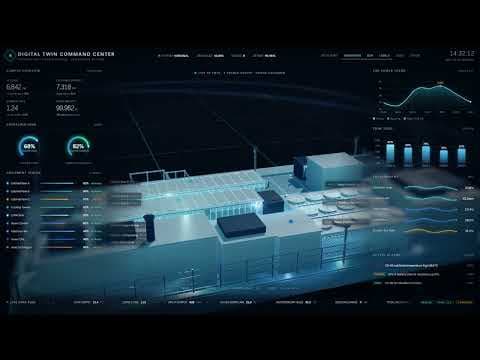
The video opens with a sweeping 3D visualization of the entire tower — its exterior form, floor plates, and structural organization rendered with striking clarity. Viewers can see how the building is broken down into floors, zones, and individual spaces. This geometric fidelity matters: when a facility manager needs to locate a specific air handling unit or trace a plumbing riser, they can navigate the twin visually instead of digging through archived documentation.
Real-Time Data Meets 3D Visualization
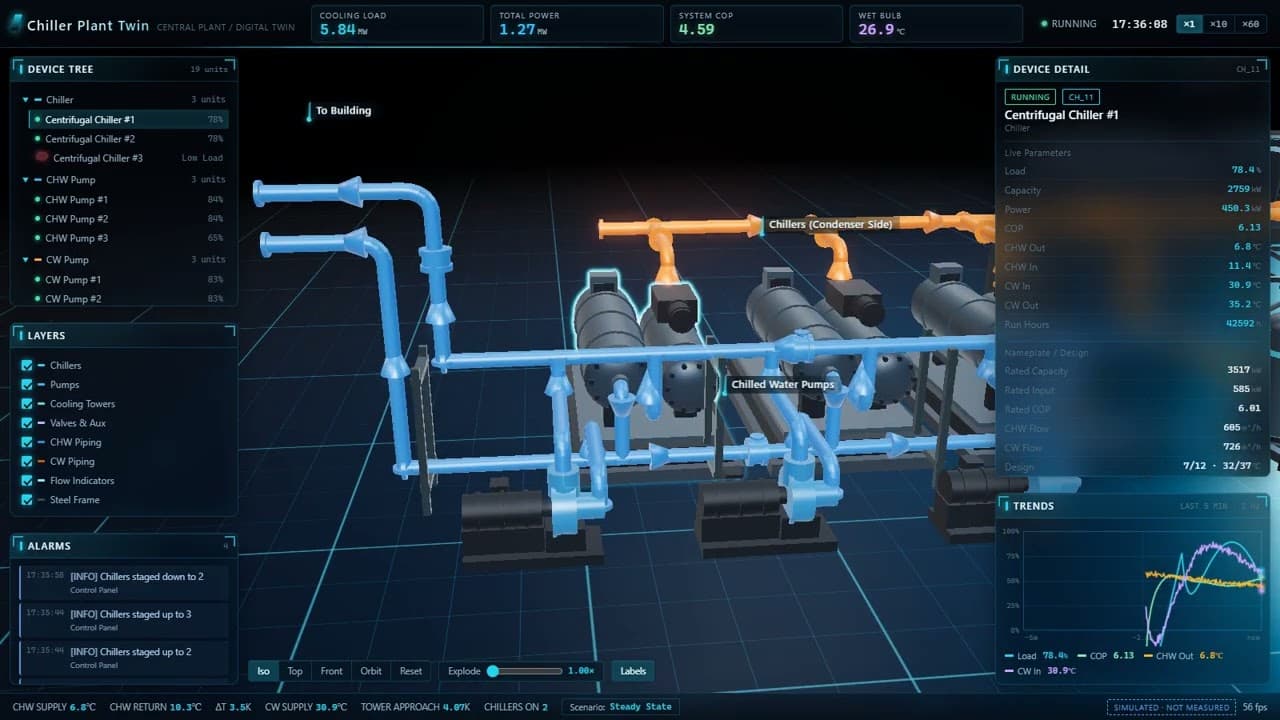
As the video progresses, the model becomes more than geometry. Systems and equipment are highlighted, queried, and inspected. The twin acts as an interactive interface: click on a system, and you see its status, parameters, and related documentation. This is the defining characteristic of a true digital twin — the fusion of where things are with how things are performing.
A Single Pane of Glass for Building Operations
Perhaps the most important takeaway from the video is the sense of command it conveys. Rather than toggling between a BMS, an energy dashboard, a maintenance platform, and a set of drawings, the digital twin consolidates everything into one navigable environment. For a tower with dozens of mechanical rooms, hundreds of sensors, and thousands of data points, that consolidation is transformative.
Watch the video and you'll notice how intuitively the interface guides the eye. That's deliberate. A digital twin succeeds only if its users — many of whom are not software engineers — can actually derive insight from it. Contexus has clearly designed with usability in mind.
The Business Case: Why Digital Twins Pay for Themselves
Digital twins are not a futuristic novelty; they are an operational investment with quantifiable returns. Here's where the value concentrates.
1. Energy Optimization and Sustainability
Energy is typically one of the largest controllable operating expenses in an office tower. Research from McKinsey & Company and Deloitte suggests that buildings deploying smart-building analytics and digital twin technologies can reduce energy consumption by 10–20%, with well-executed programs achieving even more. When a twin reveals, for example, that an entire floor is being conditioned overnight despite zero occupancy, that's money leaking out of the building — visible within days of going live.
For companies with net-zero commitments, a digital twin also becomes the audit-ready backbone of ESG reporting, tracking consumption, emissions, and efficiency measures in a verifiable way.
2. Predictive Maintenance
Industry studies consistently show that predictive maintenance strategies can reduce maintenance costs by 18–25%, cut unplanned downtime by up to 50%, and extend equipment life by 20–40%. A digital twin makes predictive maintenance practical by anchoring sensor data and analytics to the actual physical assets. Instead of a generic alert saying "vibration anomaly detected," the twin shows you precisely which unit, on which floor, in which room — along with its service history.
3. Space Utilization and Tenant Experience
Post-pandemic, hybrid work has made space utilization unpredictable. Multiple workplace studies have found that office utilization rates frequently hover at 50–60% of pre-2020 levels, leaving owners and tenants paying for space that sits empty. A digital twin with occupancy analytics allows operators to right-size conditioning, cleaning, and leasing strategies — and to give tenants transparency about how their space performs.
4. Capital Planning and Renovations
When it's time to retrofit, upgrade, or repurpose a tower, the digital twin becomes an indispensable planning tool. Stakeholders can simulate changes, assess impacts, and coordinate work — all before a single wall is touched. This shortens project timelines and reduces costly surprises during construction.
How a Digital Twin of an Office Tower Actually Works
Understanding the mechanics demystifies the technology. A production-grade digital twin like the one shown in the Contexus video typically rests on three layers:
Layer 1: Data Collection
IoT sensors, meters, BMS points, access-control systems, and even occupant feedback apps feed continuous streams of data into the platform. Modern twins are also hardware-agnostic, meaning they can integrate data from the mixed ecosystem of devices most existing towers already have installed.
Layer 2: Integration and Modeling
This layer harmonizes the data with a structured digital representation of the building — its geometry, systems hierarchy, and asset registry. Standards such as BIM (Building Information Modeling) and open data protocols ensure the twin reflects the building as it truly is, not as an idealized schematic.
Layer 3: Visualization and Decision Support
Finally, the twin presents everything through an intuitive 3D interface — the exact experience the Contexus video showcases. Users navigate the tower, drill into systems, review trends, receive alerts, and act. Increasingly, analytics and AI layers sit on top, flagging anomalies and recommending optimizations automatically.
Real-World Momentum: The Industry Is Moving
Contexus is far from alone in recognizing the potential — but it is part of a vanguard making digital twins accessible and practical for real buildings. Consider the broader landscape:
- Gartner named digital twins among its top strategic technology trends for multiple consecutive years, and estimated that a majority of large industrial companies would deploy the technology in some form.
- Major global landlords and institutional investors increasingly require digital representation and live operational data as a condition of asset acquisition, viewing twins as risk-reduction and value-assurance tools.
- Cities including Singapore have built nation-scale digital twins, demonstrating that the approach scales from a single tower to entire urban districts.
What videos like Contexus's accomplish is making this trend tangible. Abstract market forecasts become concrete the moment you see an actual office tower rendered, connected, and queryable on screen.
Who Benefits from a Digital Twin?
The short answer: nearly every stakeholder in commercial real estate.
- Building owners gain a transparent, data-backed view of asset health and performance — critical for valuation, transactions, and portfolio strategy.
- Facility and property managers work faster and smarter, with diagnostics, documentation, and alerts unified in one place.
- Corporate tenants get verifiable insight into comfort, air quality, and sustainability performance of the space they occupy.
- Engineers and consultants plan retrofits and upgrades with confidence, working from an accurate digital baseline.
- Sustainability officers finally have a single, credible system of record for energy and emissions reporting.
How to Get Started with a Digital Twin for Your Building
Inspired by the video? Here's a pragmatic path forward:
- Define your objectives. Energy savings, maintenance efficiency, tenant experience, or ESG reporting — pick your top two or three priorities to shape scope.
- Audit your existing data. Most towers already have BMS systems, meters, and documentation. The twin's job is to connect and unify them.
- Start with one building or one system. A single tower — or even a single HVAC plant — is a perfect pilot before portfolio-wide rollout.
- Choose an open, scalable platform. Avoid lock-in; ensure the twin can grow with your needs and integrate future devices.
- Measure, communicate, expand. Document your baseline, quantify improvements, and use early wins to build organizational buy-in.
Frequently Asked Questions
1. What exactly is a digital twin of an office tower?
It's a live virtual replica of the physical building that combines 3D geometry with real-time operational data — equipment status, energy use, occupancy, and environmental conditions — so stakeholders can monitor, analyze, and optimize the building from a single interface.
2. How is a digital twin different from a BIM model?
A BIM model is primarily a static design and construction dataset. A digital twin takes that structural knowledge and connects it to live data streams, making it a dynamic operational tool rather than a reference document.
3. Do I need to install sensors throughout my building?
Not necessarily. Most buildings already generate significant data through existing BMS points, meters, and access systems. A digital twin platform like Contexus typically integrates what you have first, then recommends targeted sensor additions where visibility gaps exist.
4. How long does it take to create a digital twin of an existing tower?
It depends on building size, documentation quality, and system integration complexity. Pilot projects for a single tower often move from kickoff to a working twin within a few months, with depth and analytics expanding over time.
5. Is building data secure in a digital twin platform?
Reputable platforms treat security as foundational, employing encryption in transit and at rest, role-based access controls, and compliance with data protection regulations. Data ownership typically remains with the building owner.
6. What kind of ROI can I realistically expect?
While results vary, commonly reported benefits include 10–20% energy savings, double-digit reductions in maintenance costs, faster fault resolution, and improved tenant retention — often delivering payback within a few years, sometimes faster.
7. Can a digital twin work for older buildings?
Yes. In fact, older towers often have the largest optimization opportunities. The twin platform can work with legacy systems and gradually incorporate modernization as the building evolves.
Conclusion: See the Future of Your Building Today
The office tower in the Contexus video is more than a demonstration — it's a preview of how every complex building will be managed in the coming decade. Digital twins turn buildings from opaque, reactive cost centers into transparent, proactive, optimizable assets. The technology is proven, the economics are compelling, and the tools are ready today.
The best way to understand the impact is to see it for yourself. Watch the Contexus video, and pay attention to how naturally you can navigate, query, and comprehend the tower on screen. Then imagine that same clarity applied to your own building portfolio.
👉 Watch now: Contexus digital twin of an office tower — and when you're ready to explore what a digital twin could do for your property, reach out to the Contexus team to start the conversation. Your building already has a story to tell. A digital twin lets you finally hear it.