Digital Twin Command Center for a Modular Data Center Campus
Somewhere right now, a data center campus is being built the way you'd build a city block: module by module, hall by hall, with new capacity energizing while the previous phase is still being commissi...
Plays while this video is on screen. Use the player controls to turn sound on.
Somewhere right now, a data center campus is being built the way you'd build a city block: module by module, hall by hall, with new capacity energizing while the previous phase is still being commissioned. There is no grand opening. There is only a rolling sequence of handovers — and a growing pile of as-built documentation that never quite matches the thing standing in the desert.
That's the paradox at the heart of modular data center design. Modularity buys you speed, capital efficiency, and the ability to scale in lockstep with demand. It also guarantees your campus will be a moving target for its entire operational life — and traditional monitoring stacks were never built for a moving target.
The digital twin command center was invented to solve exactly that problem, and it's the subject of Contexus's video breakdown, Digital Twin Command Center for a Modular Data Center Campus. It's one of the clearest explanations of the concept available anywhere, and if you design, operate, or finance data center capacity, it deserves twenty minutes of your attention. What follows is the deeper context behind it.
Why Modular Campuses Became the Default
The shift didn't happen because modularity is fashionable. It happened because demand outran the construction industry's ability to deliver.
Hyperscale operators now run well over a thousand large data centers between them, and capacity has been roughly doubling every four years as AI training and inference workloads soak up every megawatt the industry can produce. A traditional stick-built facility can take three to five years from land acquisition to first rack. A modular approach compresses the critical path dramatically by moving fabrication into a factory, where power skids, cooling modules, and prefabricated halls are assembled in parallel with site work.
Analysts tracking the sector consistently find that prefabricated and modular methods shave months — sometimes a full year — off deployment schedules while improving consistency across repeated builds. When you're trying to add capacity faster than your competitors, that's not an optimization. That's the whole ballgame.
But speed has a cost, and the cost isn't financial. It's operational visibility.
The Operational Gap Modularity Creates
Here's what a phased modular campus actually looks like from the inside:
- Phase 1 goes live with its own switchgear, its own cooling loop, and its own commissioning baseline.
- Phase 2 arrives eighteen months later with a revised design, a different vendor's UPS, and a slightly different control philosophy.
- Phase 3 is thrown up in six months to meet an anchor tenant's deadline, and some of the as-built documentation is still being finalized when the first servers power on.
Every one of those phases changes the campus. Files get renamed. Points lists drift. The single-line diagram in the O&M manual describes a facility that no longer exists. Meanwhile, the operations team is expected to run the whole thing as one coherent plant — balancing load, managing redundancy, and keeping PUE inside contractual limits — using a patchwork of vendor tools that don't talk to each other.
Industry outage data has pointed in the same direction for years: human error and process failures account for a substantial share of significant data center outages, and the majority of incidents carry six-figure price tags, with a meaningful minority exceeding seven figures. Most of those failures aren't caused by bad equipment. They're caused by operators making decisions with incomplete or stale information.
That's the gap a digital twin command center closes.
What Is a Digital Twin Command Center?
A digital twin is a living, software-based replica of a physical asset that stays synchronized with it. A digital twin command center wraps that replica in the operational interfaces, workflows, and analytics that let a team actually run the campus from it.
Think of it as three stacked layers.
The Physical Layer
Real equipment: generators, switchgear, chillers, CDUs, PDUs, racks, and the network fabric connecting them. This layer generates the truth — the telemetry that everything above depends on.
The Data Layer
The integration fabric that normalizes thousands of points from BMS, EPMS, DCIM, and IT monitoring systems into a common model. This is the unglamorous part, and it's where most projects live or die. A twin fed by bad data is just an expensive dashboard.
The Simulation Layer
The part that makes it a twin rather than a view. Because the model understands how components relate — which breaker feeds which bus, which chiller serves which hall — it can answer questions nobody built a report for. What happens to redundancy if we take this UPS down for maintenance during peak load? Which racks go dark in a Tier III failure scenario? What's the real cost of pushing another 400 kW into Hall 3?
Why a Twin Matters More for Modular Than Monolithic
A campus built in one shot is a known quantity on day one. A campus built in phases is a sequence of unknowns, each one layered on top of the last.
That distinction changes the value equation in three ways.
Change management becomes continuous. On a static site, you model the facility once and update occasionally. On a modular site, every phase handover is a significant change event. A twin turns those events from documentation exercises into validated, version-controlled updates to a model that operators already trust.
Standardization becomes visible. The great promise of modular design is repeatability — build Hall A, then build Hall B identically. In practice, drift creeps in. A twin makes drift obvious, which is what lets you enforce a real design standard across a decade of expansion.
Commissioning becomes reusable. Each commissioning cycle generates test data, baseline readings, and validated sequences. A twin preserves that knowledge so Phase 4 doesn't repeat the mistakes of Phase 2.
Inside the Command Center: What Operators Actually See
Contexus's walkthrough focuses on the interface layer, and it's worth understanding what lives there.
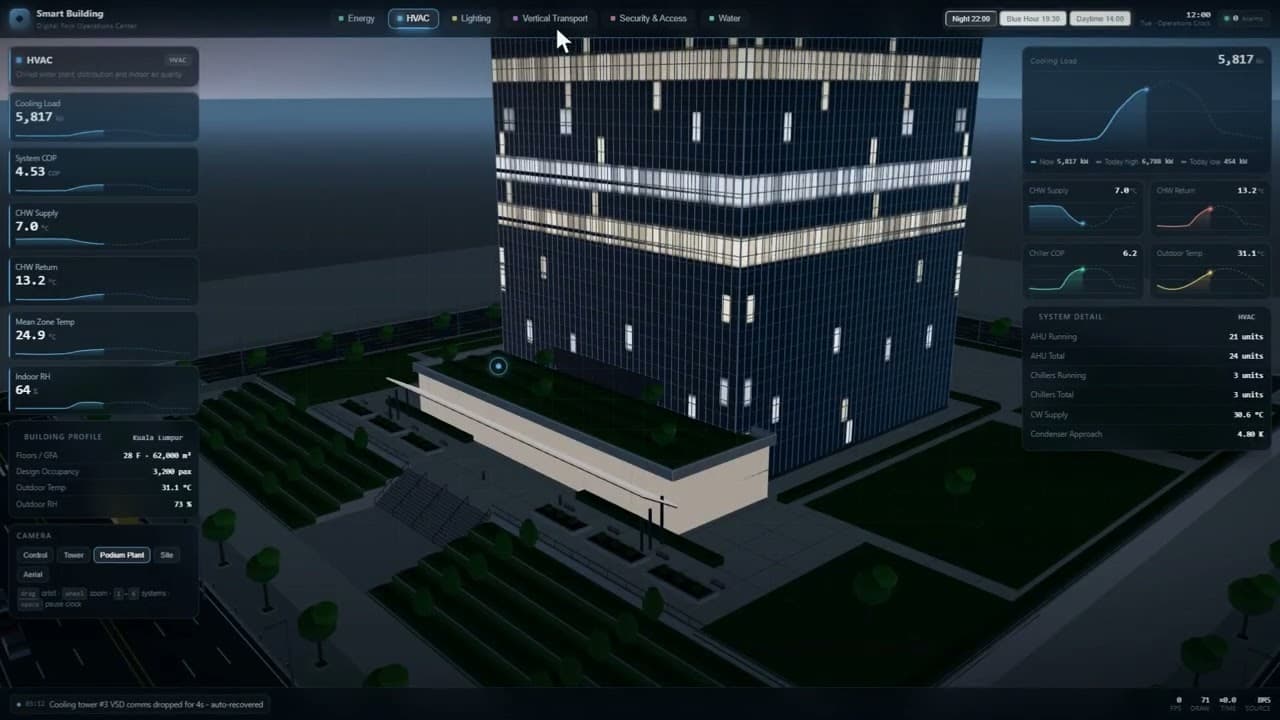
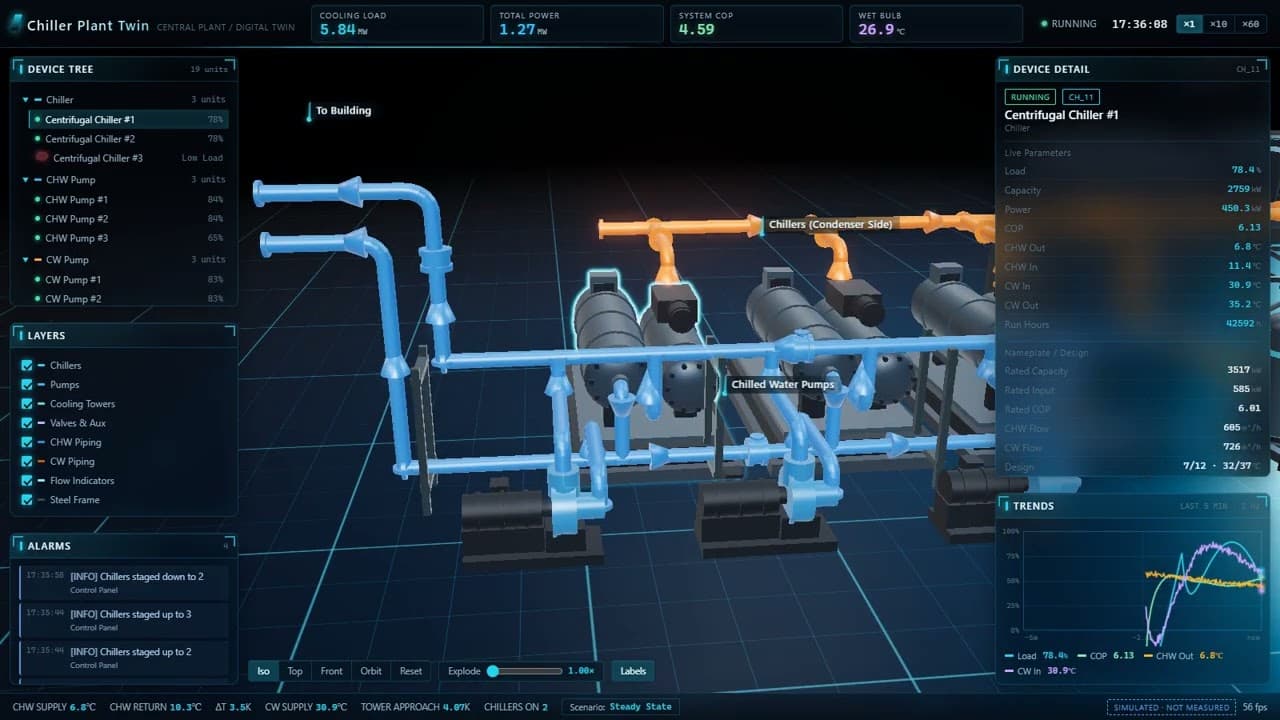
A single spatial model. Instead of tabbing between a BMS and a DCIM and an asset spreadsheet, operators navigate a 3D representation of the campus and drill from campus to hall to row to rack. Anomalies are visible in space, not buried in a point list.
Live capacity and constraint views. Where is there power? Where is there cooling? Where is there floor space? And critically, where is there all three at the same time? Stranded capacity — the capacity you own but can't monetize because one constraint blocks it — is one of the quiet killers of data center economics.
Simulation-ready workflows. Maintenance planning, failure scenario testing, and expansion modeling run against the same model the operations team uses daily, which means the answers are trustworthy rather than theoretical.
Historical context. Trending across a decade of phased builds reveals patterns no single-phase snapshot can.
A Practical Example: Phased Expansion Without a Blind Spot
Consider a common scenario. An operator runs a 12 MW campus in three halls and needs to commission a fourth. The new hall uses a higher-density cooling architecture to support AI racks at 40 kW or more per cabinet — a big departure from the 8 kW racks in Hall 1.
The team has two options. In the traditional approach, engineers spend weeks manually cross-referencing drawings, running spreadsheets, and hoping the electrical model in the spreadsheet matches reality. Any error surfaces at commissioning, when schedule pressure is highest.
With a digital twin, the team loads the Hall 4 model, runs failure scenarios against the existing utility feeds, checks whether the chilled water loop can absorb the additional load during a chiller-out event, and validates that the new redundancy topology still meets the campus SLA. Problems surface weeks earlier, when fixing them costs engineer hours rather than penalty payments.
That's the difference between reacting to your campus and operating it.
Building One Without Drowning in Data
Digital twins fail for predictable reasons. Here's how to avoid them.
Start with a scope, not a model. A twin of the entire campus built to millimeter precision is a multi-year science project. A twin of your electrical distribution and cooling topology, integrated with live data, is a six-month win. Start where failure costs the most.
Fix your naming conventions first. Point naming chaos is the number one cause of stalled integrations. Standardize before you integrate.
Treat the model as operational infrastructure. Assign ownership, budget for maintenance, and enforce a rule that nothing changes in the physical plant until it changes in the model.
Resist the dashboard trap. Visualizations are the easy part. Prioritize simulation capability — the ability to ask "what if" and get a defensible answer.
What Comes Next
The trajectory is clear. Digital twins are evolving from passive replicas into active participants in operations — closing the loop between prediction and control. The next wave connects twin models to AI-driven optimization engines that adjust cooling setpoints, shift workloads between halls, and even inform when to trigger a new construction phase based on real utilization trends rather than quarterly guesswork.
For modular campuses, this is a natural fit. You're already building from repeatable, standardized components. Adding a shared intelligence layer turns a collection of modules into a genuinely unified facility.
Frequently Asked Questions
What exactly is a digital twin command center? It's a software environment built around a live, synchronized replica of your physical facility, combined with the monitoring, simulation, and workflow tools an operations team needs to run the campus from it. It's not a 3D model you look at — it's a system you operate through.
How is this different from a DCIM system? DCIM records what you have and shows you what's happening. A digital twin understands how everything relates and can simulate what would happen under conditions that haven't occurred yet. Many operators run both, with the twin consuming DCIM data as one input among several.
Do I need a full BIM model to get started? No. A detailed BIM model is helpful but not required. Most successful first projects begin with accurate single-line diagrams, cooling loop schematics, and a clean point database. Fidelity can be added incrementally where it delivers value.
Does a twin help during construction and commissioning, or only after? Both. Using the twin during commissioning lets you validate against the design model in real time and hand over a facility that's already modeled and understood on day one — instead of scrambling to document it afterward.
What does it cost? Costs vary widely with campus size, data integration complexity, and modeling depth. The more useful question is what a single avoidable outage costs you. If your exposure runs into six or seven figures per event, the payback math gets short very quickly.
Who owns the data and the model? Ideally, you do — contractually and technically. Insist on open data formats and export rights. A twin you can't take with you isn't an asset; it's a dependency.
Will this eventually run my data center for me? Not unsupervised, and not soon. The realistic near-term outcome is decision support: better information, faster scenario analysis, and fewer human errors. Full autonomy will arrive incrementally, and the operators who trust their models most will be the ones who adopt it first.
The Bottom Line
Modular data centers solved the industry's speed problem and created a visibility problem in the process. A campus assembled in phases, across years, with evolving designs and mixed vendors, is inherently hard to understand — and understanding is the precondition for operating it well.
A digital twin command center restores that understanding. It gives you a single, living source of truth that grows with your campus instead of falling behind it. For operators staring down a decade of expansion, that's not a nice-to-have. It's the difference between scaling deliberately and scaling blindly.
The full walkthrough from Contexus — Digital Twin Command Center for a Modular Data Center Campus — shows how this comes together in practice, with the interfaces, workflows, and architecture laid out clearly. If this article raised questions you want answered visually, watch the video now. Then ask yourself the only question that matters: if your campus changes tomorrow, will your operations team know before something breaks?